8 Best Jewelry Organizing Hacks: Keep Your Baubles Tidy & Tangle-Free
Author:Judy
|
Released:November 18, 2025
Is there anything worse than discovering your favorite gold chain has twisted into an impossible knot just minutes before you need to leave? If you want to know how to store jewelry effectively to prevent this daily panic, you are in the right place. Read on for eight life-changing hacks that will transform your chaotic pile into a curated gallery.
1. Master The Art Of Segmentation With Velvet Drawer Inserts
The "dump and shut" method is the quickest way to ruin your investments.
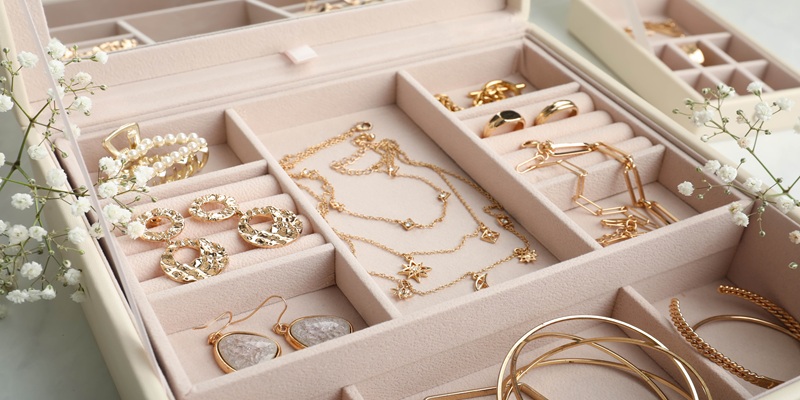
When you toss items into an empty wooden or plastic drawer, every opening and closing motion causes pieces to collide, resulting in surface scratches that dull the luster of gold and silver. This is why a high-quality jewelry drawer organizer is non-negotiable for any serious collection.
Specifically, you want to invest in velvet trays.
The science behind the velvet recommendation is simple friction. The textured fabric grips the metal, preventing the kinetic energy of the drawer's movement from causing the sliding rings to slip into necklaces.
When selecting inserts, you must choose between modular and fixed systems.
Modular trays offer flexibility, allowing you to tessellate sections like Tetris blocks based on your inventory. However, fixed custom inserts often provide a more seamless, built-in aesthetic.
Before purchasing, take precise measurements of your drawer's interior dimensions—height, width, and depth. A tray that slides around defeats the purpose of stabilization.
Furthermore, keeping gold separate from harder gemstones prevents microscopic abrasions.
A compartmentalized tray prevents a diamond from grinding against a soft 18k gold band.
2. Go Vertical: Wall-Mounted Solutions For Necklaces
While drawers are excellent for rings and studs, they can be a death sentence for delicate chains.
Gravity is the only force that can reliably keep a 14-inch chain from tangling with a 16-inch pendant. This is where a wall jewelry organizer becomes an essential tool for longevity.
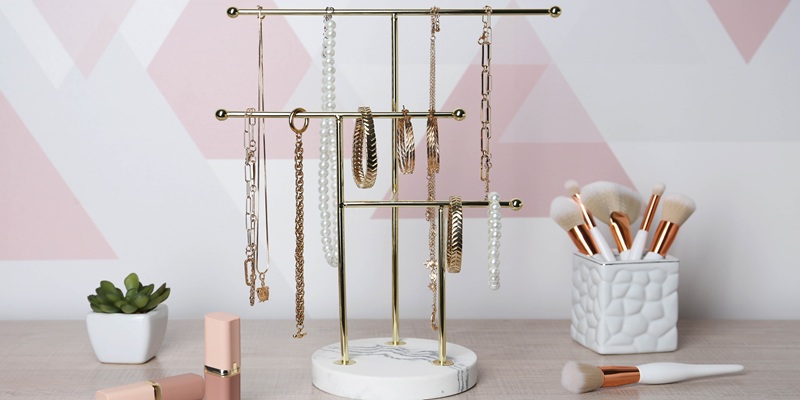
A dedicated necklace holder or mounted hooks serve a dual purpose: they utilize dead wall space and ensure chains remain elongated.
When chains are coiled in a box, the links can kink or bind, leading to Stress points that eventually break.
According to the Gemological Institute of America (GIA), proper storage is critical for maintaining the value of your pieces, specifically advising that items be kept separate to prevent scratching—a principle that vertical separation enforces naturally. Furthermore, hanging chains allows for quick visual inventory, preventing the "out of sight, out of mind" syndrome.
For renters who cannot drill holes, sturdy adhesive hooks offer a damage-free solution.
Homeowners might opt for decorative racks made of rustic wood or modern metal to match their decor.
However, consider the ambient environment when mounting these organizers. Avoid bathroom walls, where humidity accelerates tarnishing of silver and copper alloys. Instead, opt for the back of a closet door or a bedroom wall away from direct sunlight.
3. The Clarity Of Acrylic: Visualizing Your Collection
For those who prioritize visual accessibility, opaque storage can sometimes act as a barrier to usage. If you cannot see your collection, you are statistically less likely to wear it, leaving valuable pieces to gather dust. This is the primary argument for the clear jewelry box.
Modern acrylics have moved beyond cheap, brittle plastics into high-grade, durable materials that mimic the clarity of glass without the fragility.
Many organization enthusiasts successfully repurpose a high-end acrylic makeup organizer for chunky bracelets and statement pieces that do not fit in shallow velvet trays.
The transparency allows you to scan your options instantly, treating your collection as a visual palette to match your outfit. This significantly speeds up your morning routine, as you no longer need to rummage through dark boxes to find a specific item.
However, caution is required regarding placement. While acrylic is durable, it acts as a greenhouse if placed in direct sunlight. UV rays can degrade certain organic gems (like pearls or coral) and cause amethyst to fade over time. Therefore, clear organizers should be kept on dressers that receive indirect light.
This balance of visibility and protection ensures your statement pieces remain accessible without suffering environmental damage.
4. Travel Rolls: The Portable Hack You Can Use Daily
Mobility is often an overlooked variable in jewelry organization.
While a stationary armoire serves the home, the modern lifestyle is rarely static; you need solutions that transition seamlessly from a vanity to a gym locker, or from a home office to an overhead bin. This is where the jewelry roll proves superior to standard storage.
By utilizing soft structures, usually made of fabric or leather, these rolls compress the volume of your storage while immobilizing individual chains to prevent the dreaded "necklace knot" during transit.
These portable hacks are not exclusively for vacations. A compact travel jewelry case is essential for the commuter who switches from corporate attire to evening wear, or for securing valuables during a workout. Unlike hard-shell boxes that rattle, rolls absorb shock.
When selecting these carriers, prioritize interior materials over exterior aesthetics. Rough synthetic linings can act like sandpaper on softer organic gems.
For instance, pearls rank low on the Mohs hardness scale and require soft barriers, such as suede or velvet, to maintain their luster. Whether for a weekend getaway or a midday spin class, the goal is to prevent friction and impact damage.
5. Strategic DIY: Repurposing Household Items
Effective organization does not always require a trip to a container store; often, it simply requires looking at household items through a curator's lens.
DIY jewelry storage has graduated from kitschy crafts to sophisticated interior design hacks. Ceramic egg crates, for example, offer the perfect compartmentalization for stud earrings and rings, mimicking the layout of high-end velvet trays without the cost.
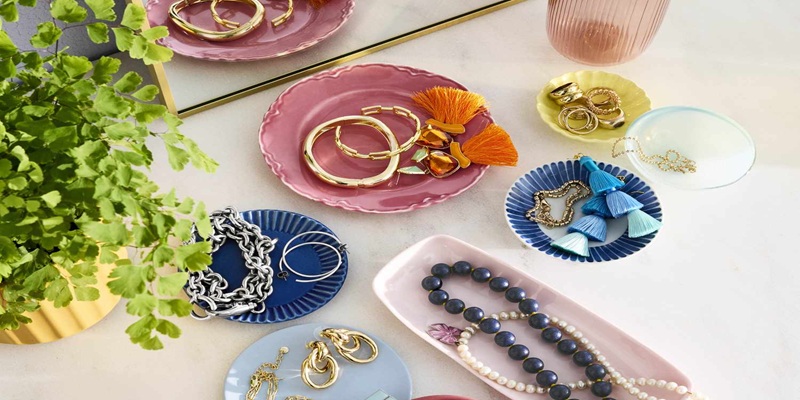
Vintage teacups and saucers serve as excellent catch-alls for daily wearables, adding an aesthetic layer to budget organization while keeping pieces accessible on your dresser.
This approach allows you to inject personality into your storage system. However, a word of caution is necessary regarding materials. Not all household containers are safe for metal. You must rigorously avoid utilizing unsealed wood or cheap plastics for long-term storage, as these materials can "off-gas" volatile organic compounds over time.
These invisible fumes often accelerate corrosion on silver and gold vermeil, undoing your organizational efforts. It is safer to stick to inert materials, such as glazed ceramics or glass, which do not emit reactive chemicals.
6. Combat Chemistry: Anti-Tarnish Storage Methods
To truly master jewelry care, one must understand the basic metallurgy at play.
Tarnish is not merely dirt; it is a chemical reaction, primarily oxidation, occurring when the surface of the metal interacts with sulfur-containing substances in the air.
This results in silver sulfide, the black or dull layer familiar to anyone with sterling silver pieces.
Because high humidity accelerates this reaction, the bathroom—despite being the most convenient place to get ready—is scientifically the worst environment for jewelry storage because of steam and moisture.
To mitigate this, you must control the micro-environment around your collection.
The most effective tool is the use of anti-tarnish strips. These small paper tabs are typically treated with activated carbon or copper to act as "sacrificial scavengers," absorbing atmospheric sulfur and pollutants before they can react with your silver.
For those seeking authoritative guidance on preservation, the Smithsonian Museum Conservation Institute emphasizes that controlling relative humidity and eliminating sulfur sources are critical for the care of silver.
If you cannot store pieces in airtight containers, ensure your drawers are lined with chemically treated felt cloth to create a passive defensive barrier against the atmosphere. By understanding the science, you can keep your silver shining bright without constant polishing.
7. The Modular Approach: Stackable Trays For Growing Collections
While creating a chemically inert environment prevents oxidation, the physical arrangement of your pieces dictates your daily efficiency.
A standard error in jewelry organization is purchasing a large, monolithic armoire or a rigid, multi-tiered box. These static solutions often result in wasted space or, conversely, overcrowding as your collection evolves.
The superior alternative for the modern collector is investing in stackable jewelry trays.
This approach prioritizes customizable storage. Rather than forcing your collection to fit a pre-set container, you build the container around your collection.
We recommend a conservative entry point: start with just three layers—a top tier for daily rings and studs, a divided middle section for necklaces, and an open bottom tray for chunky bracelets.
This modularity allows you to expand vertically only when necessary, keeping your vanity footprint minimal.
Check for standard sizing when buying trays so you can mix and match brands if needed.
By using velvet-lined stackers, you also provide the necessary friction to keep pieces from sliding during retrieval, marrying the benefits of open display with the protection of a drawer system.
8. The 'One-In, One-Out' Inventory Rule
Even the most sophisticated architectural storage systems will fail if the volume of inventory exceeds physical capacity.
The entropy of a jewelry collection is inevitable without active curation. To maintain a functional system, you must apply rigorous inventory rules, with a specific focus on decluttering jewelry on a scheduled basis.
We advocate for the 'One-In, One-Out' protocol: for every new statement necklace or pair of earrings you acquire, an existing item must be archived, donated, or sold.
Maintaining a minimalist jewelry collection does not imply owning very few items; instead, it means that every item in your active rotation serves a purpose.
Implement a quarterly review of your trays. If a piece has not been worn in four consecutive quarters—covering every seasonal shift—it is effectively dead stock, taking up prime real estate.
Move these items to long-term storage or remove them entirely to free up space. This discipline prevents the 'morning tangle' from returning. It ensures that your stackable trays remain a tool for efficiency rather than a repository for the forgotten items you no longer love.
Reclaim Your Morning Routine
Ultimately, the goal of reorganizing your jewelry extends beyond the aesthetic pleasure of a tidy vanity; it is a serious investment in time management. By understanding the metallurgy of tarnish and adopting modular systems, you reduce the friction of getting dressed, saving valuable minutes every morning. However, remember that the most sophisticated system is useless if it is too cumbersome to maintain; the best system is simply the one you actually use. Ready to transform your vanity? Select one of these hacks to implement this weekend and say goodbye to the morning tangle.
Sources
Gemological Institute of America - Jewelry Care and Cleaning Guide
You May Like
Fashion Trends
Quiet Luxury On a Budget: 7 Affordable Brands That Look High-End

Fashion Trends
Street Style Evolution: Fashion Trends Inspired By Urban Culture
Jewelry
8 Best Jewelry Organizing Hacks: Keep Your Baubles Tidy & Tangle-Free

Design
Core Luxury Brands for Diversified Fashion Holdings

Outfit Ideas
From Work To Weekend: Best Knee High Boots That Do It All